



Cold brew vs Iced Coffee
6 June 2025
Summer Coffee Recipes: 5 Modern Coffee Drinks to Upgrade Your Coffee Shop Menu
9 June 2026The Impact of Different Water Minerals on Coffee Extraction
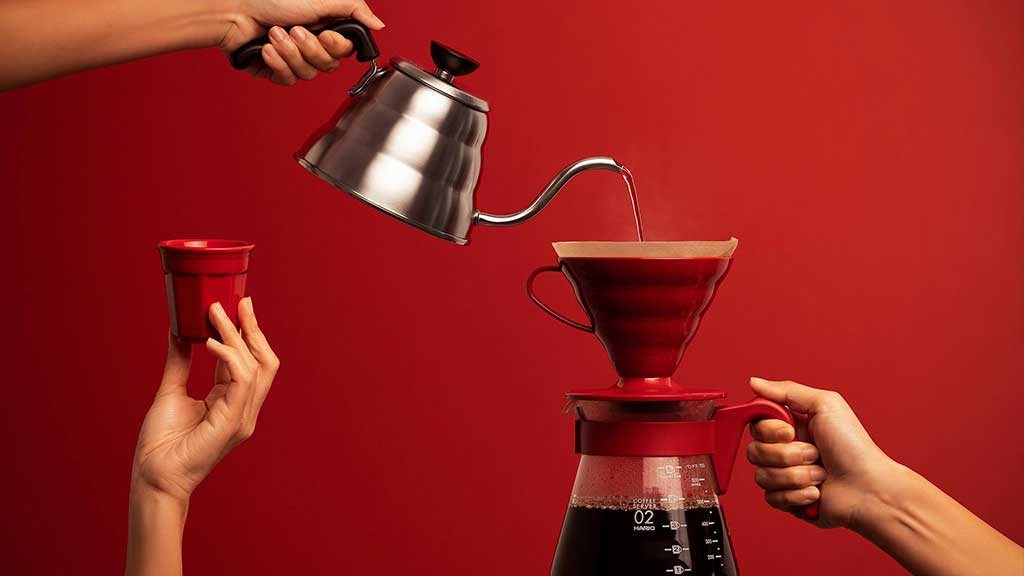
When we work on grind size, recipe, temperature, and pouring technique, we’re adjusting how we extract. But water also decides what gets extracted—and with what sensory balance. It’s not a detail: it’s applied chemistry.
It’s worth locking in one simple and powerful number right away:
In an espresso, water makes up about 90% of the final beverage.
In filter coffee, water reaches about 98.5%.
So yes: water is (almost) the whole cup. And its dissolved minerals—calcium, magnesium, bicarbonates, sodium, and other ions—are an extraction variable just as important as grind size.
Why minerals change extraction and flavor: what’s really happening
Roasted coffee contains thousands of compounds: organic acids, melanoidins, alkaloids, aromatic compounds, degraded sugars, and many molecules with chemical groups that can interact with ions in water.
Minerals affect extraction mainly through two mechanisms:
1) Solvent selectivity
Water is not a “neutral” solvent. The presence of ions—especially divalent cations like Ca²⁺ (calcium) and Mg²⁺ (magnesium)—changes solubility and affinity toward different families of coffee molecules. Result: same recipe, but a different perceived extraction.
2) Acid–base balance (buffer effect)
Bicarbonates (HCO₃⁻) determine how much “resistance” the water offers to pH changes. In barista language: they decide how much of the coffee’s acidity will be highlighted or muted.
The measurements that actually matter (and the most common misunderstandings)
1) Hardness: Ca²⁺ + Mg²⁺
This measures calcium and magnesium (often expressed as “ppm as CaCO₃”). Moderate hardness tends to support extraction and cup structure. If it’s too low, the cup can feel thin and unstable.
Typical mistake: using only water TDS as a quality indicator. Two waters with the same TDS can behave in opposite ways if bicarbonates and the calcium/magnesium ratio change.
2) Alkalinity: mainly HCO₃⁻
This measures the buffering capacity of water. It’s the variable that often explains “flat cups.”
- High alkalinity → less readable acidity, dimmer aromatics, a more uniform and opaque profile.
- Too low alkalinity → sharper acidity and a more “nervous” cup, especially if hardness is also low.
3) pH: useful, but not the steering parameter
The initial pH of water changes quickly once coffee acids enter the system. The real regulator of pH stability is alkalinity (buffer).
4) Water TDS: a control tool, not a design tool
TDS tells you how many dissolved solids are present, not which ones. It’s useful to monitor consistency and drift over time, but it does not replace hardness and alkalinity.
Mineral by mineral: how they change extraction and sensation
Magnesium (Mg²⁺): definition and aromatic yield
In many cup-quality-oriented water profiles, magnesium is associated with:
- greater aromatic clarity,
- better definition of fruity/floral notes,
- a sense of “cleanliness” and brightness if alkalinity is correctly controlled.
Calcium (Ca²⁺): structure and roundness—with limescale risk
Calcium can contribute to body and fullness, but it is also the mineral most linked to the main operational issue in espresso: limescale when water is heated (especially when bicarbonates are present).
Professional trade-off: more calcium doesn’t automatically mean “more quality,” because beyond a certain point you increase maintenance, system instability, and operating costs.
Bicarbonates (HCO₃⁻): the acidity dial
Bicarbonates don’t “extract” directly, but they modulate how extracted acids are perceived.
- If they’re too high, acidity doesn’t disappear: it becomes “switched off” and less readable. The cup loses transparency.
- If they’re too low, acidity can become aggressive and the cup unstable (especially for espresso).
Sodium (Na⁺): don’t demonize it—control it
At low concentrations it can increase perceived sweetness, but in excess it brings saltiness and distortion. Often it also indicates specific treatments (to interpret alongside the whole profile).
Chlorides and sulfates (Cl⁻ / SO₄²⁻): flavor + technical compatibility
They aren’t the primary extraction levers like Ca/Mg/HCO₃⁻, but they influence:
- aftertaste,
- corrosion (watch chlorides),
- compatibility with materials and components.
Espresso vs filter: why the same water doesn’t always work
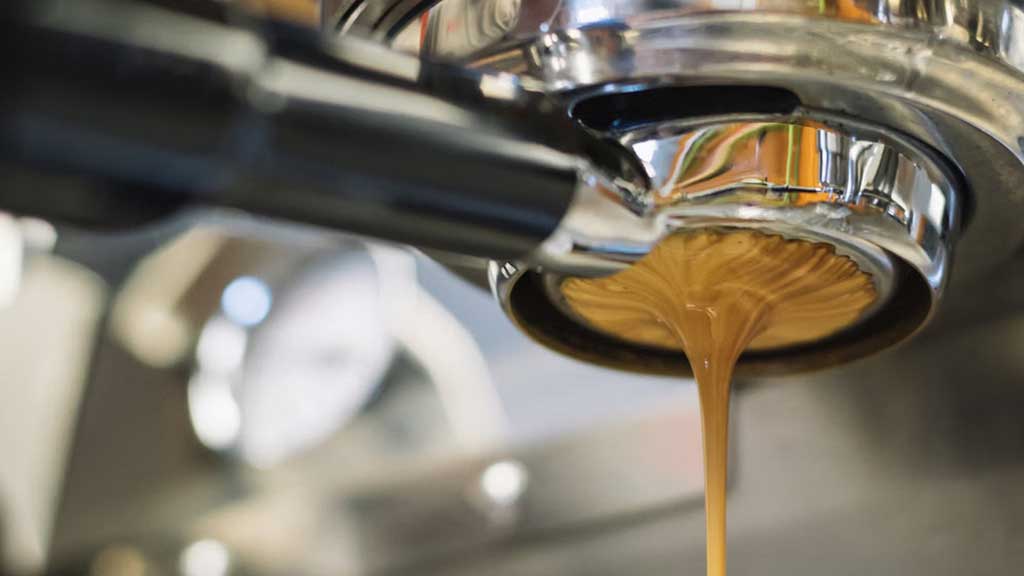
- Espresso: high concentration, high temperature, and pressure. Small water imbalances get amplified: high buffer can flatten; overly “empty” water can make espresso harsh and unstable.
- Filter: more diluted and transparent extraction. Water is more “audible” in the cup: hardness/alkalinity balance clearly affects cleanliness, definition, and aromatic clarity.
How to measure water (in a way that helps a barista)
To work seriously with water and recipe you need at least:
- Total hardness (drop test / titration)
- Alkalinity (drop test / titration)
- TDS meter for quick stability checks over time
If you run a bar with equipment and high volumes, it can make sense to add chloride checks and technical monitoring—but for cup quality the foundation remains hardness + alkalinity.
Water treatment methods for coffee
This is where confusion often happens: “filtering” doesn’t always mean “softening.” And many cartridges used in coffee aren’t sodium-exchange softeners.
1) Activated carbon (filtration)
What it does: reduces chlorine, odors, and organics that harm aroma and cleanliness.
What it doesn’t do: precisely “design” hardness and alkalinity.
It’s a sensible first step to improve palatability, but it won’t solve buffer/hardness issues on its own.
2) Filter cartridges (e.g., Brita, BWT, and similar): functional families
Many cartridges combine activated carbon with resins and specialized media. It’s more accurate to think in types rather than “brand” (each brand has multiple lines).
2.1 Buffer control / decarbonation cartridges (bicarbonate reduction)
Goal: reduce alkalinity to prevent flat cups and increase aromatic definition.
Excellent when the mains water has high bicarbonates.
2.2 Partial demineralization cartridges
Goal: reduce dissolved salts more broadly, including some hardness.
Warning: if the water becomes too “empty,” the cup can lose body and sweetness.
2.3 Magnesium-oriented profiles (“Mg²⁺ boost” approach)
Goal: maintain technical control and favor a profile that often delivers better aromatic definition than very calcium-heavy waters (depending on cartridge and setup).
Golden rule: cartridge life is not based on the calendar. It’s managed in liters, based on incoming water and the media type.
3) Classic ion-exchange softening (Ca²⁺/Mg²⁺ → Na⁺)
Reduces hardness and therefore limescale, but can increase sodium and alter sensory balance. Technically valid in some contexts, but it must be understood and monitored.
4) Reverse osmosis (RO) + remineralization
This is the maximum-control approach: you stabilize water by removing most mineralization, then rebuild a target profile.
It requires more management, but it’s the most reliable way to standardize quality and repeatability—especially for advanced professional contexts or multi-location businesses.
Espresso Academy classroom test: “Three waters, one recipe”
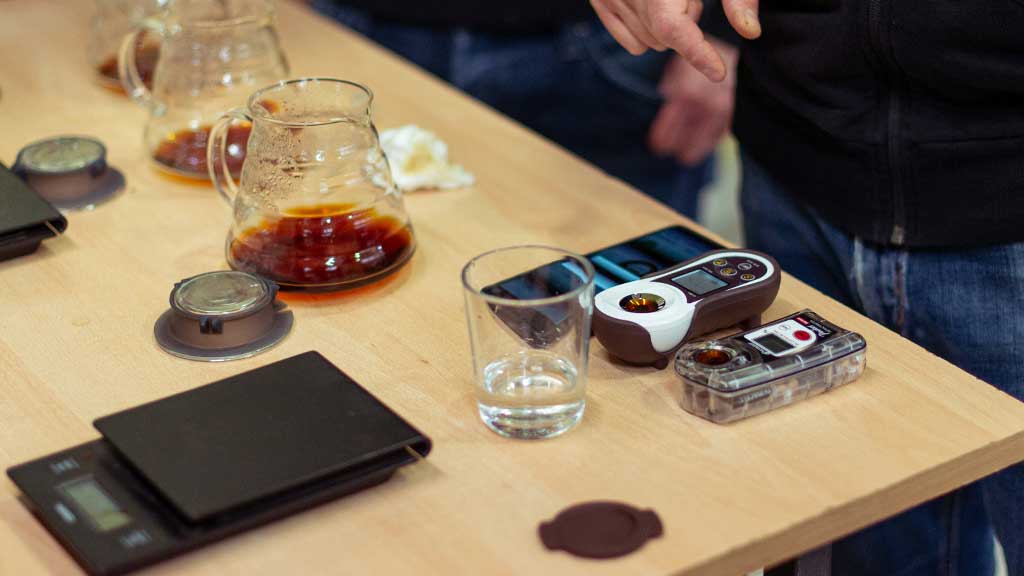
During one of the latest Espresso Academy Coffee Brewing courses, we ran a very direct practical test: same coffee, same recipe, same hand… three different waters. The purpose was to let students taste that water is an extraction dial—not a neutral element.
The setup (identical—only the water changes)
We chose a washed coffee, medium-light roast, with citric acidity and floral/fruity notes: perfect for highlighting differences in transparency and definition.
- Method: V60 (single cup)
- Dose: 18 g
- Total water: 300 g (about 60 g/L)
- Temperature: 93°C
- Filter: paper (same batch)
- Grind: fixed (not changed between tests)
- Pouring: 45-second bloom, then two pours to 300 g
- Target time: 2:50–3:10
Before tasting, we quickly measured hardness and alkalinity—just enough to connect numbers to the cup.
The three waters
Water 1 — very light, low buffer
Low hardness and low alkalinity: typical “too soft” or overly stripped water.
Water 2 — balanced
Medium hardness and moderate alkalinity: a profile that tends to deliver complexity without flattening.
Water 3 — more mineralized, high buffer
Higher alkalinity (bicarbonates) and higher mineral load: common with many hard mains waters.
What happened in the cup
With Water 1, the cup was bright but fragile: immediate acidity, thinner body, less sweetness, and a slightly drying finish. In class, someone said: “It’s good, but it feels like something is missing.”
Classic “too low mineral” effect: liveliness, yes—but little structure.
With Water 2, everything became more stable and readable: acidity present but integrated, clearer sweetness, more defined aromatics, and a longer finish. The clearest comment was: “This is the one I’d drink every day: clean, clear, but also sweet.”
With Water 3, the cup was rounder and fuller but lost aromatic transparency: acidity was reduced and less readable, aromatics less bright, finish more opaque. A perfect observation was: “It’s not bad… but it’s like the aromas are behind glass.”
Classic high-buffer effect: bicarbonates mute acid perception and flatten complexity.
The key lesson that stuck
At the end we asked: “If I had only served you cup #3, what would you change?”
The first answers were grind, temperature, time. Then the real key emerged: in that case the limit wasn’t the recipe—it was the water. Because everything else was identical.
Quick diagnosis: symptom → likely cause → practical correction
| Symptom in cup / extraction | Likely cause (water) | Practical correction (treatment) |
| Flat cup, “muted” aromatics, acidity hard to read | High alkalinity (high bicarbonates) | Buffer-control/decarbonation cartridge or RO + remin; measure and lower alkalinity |
| Espresso round but opaque, “chalky” finish | High bicarbonates, often with high hardness | Reduce alkalinity and rebalance hardness; avoid “carbon only” as the solution |
| Thin cup, low sweetness, no body | Hardness too low (low Ca/Mg) | Avoid excessive demineralization; choose a less aggressive cartridge or remineralize (often Mg helps) |
| Sharp/harsh acidity, instability | Alkalinity too low + water too soft | Slightly increase alkalinity or use more balanced water; check hardness |
| Bitter/astringent even with correct recipe | Imbalanced hardness/alkalinity and/or altered percolation | Rebalance hardness and alkalinity; verify cartridge; check changes over time |
| Rapid limescale in espresso machine | High hardness (Ca) + bicarbonates + heat | Effective hardness and/or buffer treatment; liter-based cartridge management; scheduled maintenance |
| Clean but overly neutral cup, short aromatics | Over-demineralization (RO without remin or overly aggressive cartridge) | Reintroduce minerals and target profile; reduce treatment aggressiveness |
| Strong variability day to day | Cartridge near end-of-life or variable mains water | Periodic measurements; liter-based replacement; consider RO to standardize |
Conclusion: water is an extraction variable, not an accessory
If you want repeatable quality and real control over sensory profile, water must be treated like a recipe parameter:
- Hardness (Ca²⁺ + Mg²⁺): supports extraction, affects structure and definition.
- Alkalinity (HCO₃⁻): controls perceived acidity and aromatic transparency.
- Treatment: carbon, selective cartridges, ion exchange, RO + remin—different tools for different goals.
In everyday bar work and within Espresso Academy training programs, working on water means cups that are cleaner, more consistent, and more “readable”—while also protecting equipment and reducing maintenance costs.