


How to Steam Milk for Cappuccino: A Complete Microfoam Guide
11 February 2026
Espresso Machine Maintenance: Essential Checklist for Baristas and Home Baristas
10 March 2026How Espresso Flavor Changes by Varying Espresso Flow at the Group Head

In the world of espresso, we often talk about grind size, dose, temperature, and pressure.
On more advanced espresso machines, however, there is another decisive sensory lever: espresso flow at the group head.
When we talk about flow profiling espresso, we are not referring to the “flow in the cup” (which is an outcome), but to the water flow rate set or modulated before the water reaches the coffee puck.
By changing espresso flow, we directly influence:
- how the coffee is wetted,
- the mechanical stability of the puck,
- how pressure develops inside the puck,
- extraction selectivity and therefore the sensory profile (sweetness, acidity, body, cleanliness).
With the same dose and yield in the cup, everything can change.
What Is Espresso Flow at the Group Head
Espresso flow refers to the water flow rate leaving the group head and reaching the coffee bed.
On modern espresso machines, this flow rate can be:
- fixed, determined by pump, hydraulic design, and restrictors;
- manually adjustable, via a needle valve or paddle;
- electronically controlled, through a programmed flow profiling curve.
When we talk about “profiling,” we mean defining how the flow rate changes over time during the shot.
Typical Espresso Flow Rates at the Group Head
Without being dogmatic, machines that allow flow control often operate within these approximate ranges, measured at the group head, not in the cup:
- initial phase / pre-wetting: about 1–2 mL/s
- main extraction phase: about 2.5–4 mL/s
- final phase: stable or slightly reduced, about 2–3 mL/s
These values should be seen as guidelines, not rules.
Actual flow behavior depends on:
- above all the puck resistance (grind size, dose, distribution, and tamp).
- group head design and pump type,
- restrictors and OPV settings,
- basket geometry,
Why Espresso Flow Changes Espresso Flavor
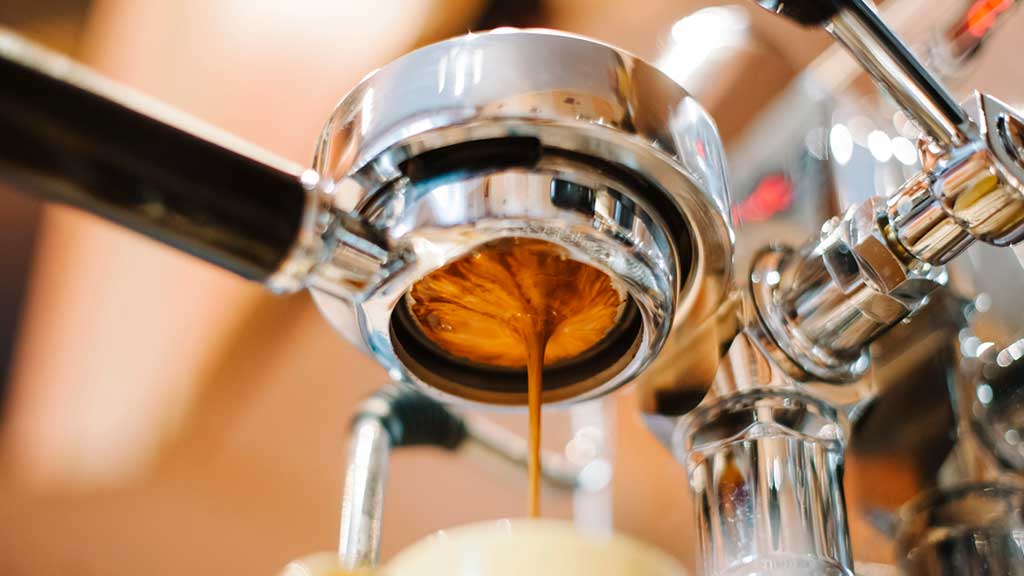
The initial phase of espresso extraction is extremely delicate: the puck transitions from compressed dry coffee to a saturated porous filter.
Espresso flow directly affects three key mechanisms.
Espresso Flow and Puck Wetting
- High initial flow
Aggressive wetting, higher mechanical stress, and a greater risk of micro-fractures and channeling if puck preparation is not perfect. - Low initial flow
Progressive hydration, reduced stress, and a more stable puck.
In the cup, this translates into a dramatic difference: a stable puck favors sweetness and clarity, while channeling produces a mix of sharp acidity and dry bitterness in the same shot.
Espresso Flow and Pressure Development Inside the Puck
With flow profiling, pressure is often a resulting variable:
- higher flow → pressure rises until it matches puck resistance;
- lower flow → pressure rises more slowly or remains lower.
By modulating espresso flow, we are effectively shaping the real pressure curve inside the puck, with direct sensory consequences.
Espresso Flow and Cleanliness of the Finish
As the shot progresses, puck resistance changes:
it becomes saturated, fines migrate, and erosion occurs.
If high flow rates are maintained while resistance drops, percolation accelerates, often leading to a dry, rough, or bitter finish.
Reducing espresso flow in the second half of the shot helps maintain a cleaner, more composed extraction.
Flow Profiling vs Pressure Profiling in Espresso Extraction
Pressure profiling
A pressure curve is set (e.g. 2 bar → 9 bar → 6 bar).
The actual flow through the puck depends on puck resistance.
Advantage
Direct control of extraction “force.”
Limitation
The same pressure can result in very different flow rates between shots.
Flow profiling
A flow curve is set (e.g. 1.2 g/s → 3.0 g/s → 2.2 g/s).
Pressure develops as a consequence of the resistance encountered.
Advantage
Precise control of puck wetting and evolution, often resulting in greater uniformity and cup cleanliness.
Limitation
Requires accurate puck preparation, as errors become immediately visible.
Operational summary
- with pressure profiling, you choose pressure and accept the resulting flow;
- with flow profiling, you choose flow and observe how pressure develops.
How Espresso Flavor Changes When Espresso Flow Is Varied
High Espresso Flow (Especially Early in the Shot)
Sensory tendency
- stronger initial impact
- more pronounced but less integrated acidity
- shorter sweetness
- higher risk of roughness and aromatic inconsistency
When it can make sense
- darker roasts
- extremely stable pucks
- recipes aimed at impact rather than finesse
Low Initial Espresso Flow with Gradual Increase
Sensory tendency
- greater uniformity
- clearer sweetness
- more elegant, integrated acidity
- cleaner finish
Risk
If flow remains too low for too long, cups may feel dense, muted, or dry, especially with darker roasts.
Practical Espresso Flow Profiles
(Indicative values – the logic applies to any machine with flow control)
Controlled Pre-Wetting + Gradual Flow Increase
- 6–10 seconds at low flow
- gradual increase to a medium flow
- moderate maintenance
- slight reduction at the end
Typical cup: sweetness, clarity, integrated acidity.
Rapid Flow Increase Profile
- high flow set almost immediately
- possible correction afterward
Typical cup: brightness and impact, but low tolerance for puck defects.
Progressive Flow Reduction in the Second Half
- medium flow after the initial phase
- gradual reduction toward the end
Why it works
As puck resistance decreases, reducing flow helps avoid over-percolation and harsh finishes.
Classroom Test: How Espresso Flow Changes the Cup
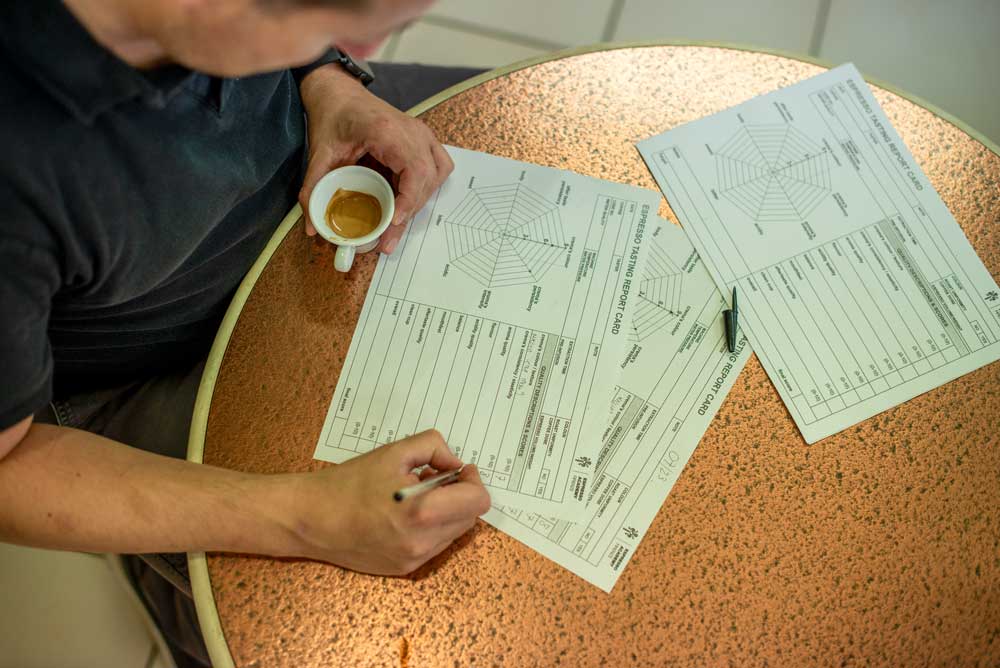
During a recent practical module at Espresso Academy, we focused on espresso flow control through a simple comparative test.
Controlled Setup
- coffee: medium-light roast single origin
- dose: 18 g
- yield: 40 g
- temperature: constant
- baskets and portafilters: identical
- puck preparation: WDT, distribution, consistent tamp
- grind size: unchanged
Shot A – Early High Espresso Flow
In the cup
- immediate, bright attack
- acidity more evident but less integrated
- shorter sweetness
- drier finish, sometimes slightly rough
Shot B – Low Initial Flow + Gradual Increase + Slight Final Reduction
In the cup
- more elegant acidity
- clearer and longer sweetness
- finer, creamier body
- cleaner and more coherent aromatic finish
Didactic conclusion
Espresso flow control does not “fix” a bad puck; it optimizes uniformity and selectivity when puck preparation is correct.e” an unstable puck; it optimizes uniformity and selectivity when puck prep is correct.
Espresso Defects Related to Espresso Flow and How to Correct Them
| Symptom in the cup | Likely flow-related dynamic | Recommended adjustment |
| Sharp acidity, low sweetness, short finish | Initial flow too high, aggressive wetting | Low initial flow 6–10 s + gradual increase |
| Acid + dry bitterness together | Micro-channeling (puck instability) | Reduce initial flow + more progressive ramp; re-check puck prep |
| Rough/dry finish | Flow too high in the second half as resistance drops | Progressive flow reduction toward the end |
| “Compressed,” dark, dry cup | Flow too low for too long | Increase mid-phase flow or shorten low-flow phase |
| Undefined aromatics | Curve too aggressive or mismatched to the coffee | More even pre-wet + gradual increase + controlled finish |
Why Espresso Flow Control Is a Modern Barista Skill
On high-performance espresso machines, controlling espresso flow at the group head allows intentional management of:
- puck wetting,
- pressure development,
- percolation stability,
- and finish cleanliness.
It is a modern, practical skill: it does not replace puck preparation, but completes it—allowing the same coffee to be shifted toward sweetness and clarity or toward impact and brightness, with consistency and repeatability.place puck preparation—it completes it. It lets you shift the same coffee toward more sweetness and clarity or toward more impact and brightness, with consistency and repeatability.